Vertical Racks turn unused vertical space into organized storage for long, bulky, or flat materials. They can hold lumber, pipes, steel bars, sheet goods, and other items that are awkward to stack on ordinary shelving. The right design can free floor space and make stock easier to identify. But a rack that suits plywood may not safely support heavy steel lengths.
This guide introduces ten common types of Vertical Racks and explains how their designs serve different storage needs. It considers features such as upright height, arm layout, load capacity, access from one or both sides, and compatibility with handling equipment. A cantilever rack, for example, offers open arms for long materials, while an A-frame rack may keep panels upright and visible. Small details matter. Aisle width, item length, and how often workers retrieve stock can change which option makes sense.
Rack names and configurations sometimes overlap, and product labels alone do not confirm suitability. Check the manufacturer’s rated capacity, installation requirements, and guidance for the materials being stored. Consider how loads are placed, secured, and removed—not just how much floor space a rack saves. The comparisons ahead provide a practical starting point, though they cannot replace a site-specific assessment. That distinction is easy to miss. A careful choice balances storage density with safe access, stable support, and the realities of daily work.
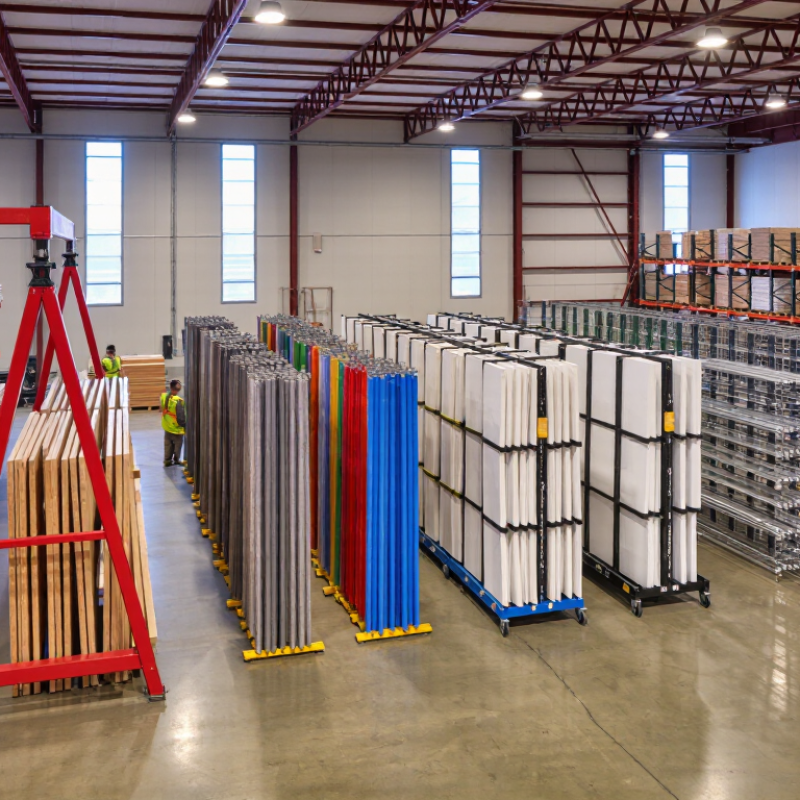
Vertical racks are best classified by what they hold, not by appearance alone. A rack for plywood needs broad, steady supports; a rack for lumber needs slots that keep boards separated and easy to lift. Fit matters. These categories can overlap, and a mixed-use rack may work less neatly than expected.
For sheet panels, A-frame racks support boards at a slight angle. Cantilever racks hold long lumber with open arms.
Pipe racks use divided pockets to stop round stock from rolling. Bar-stock racks separate straight metal lengths by size. Coil racks cradle heavy rolls to limit movement.
Door racks use padded dividers to protect finished edges. Ladder racks provide narrow bays for long, lightweight equipment.
Tire racks hold tires upright, with enough clearance for removal. Tool racks use hooks or shaped holders for visible, quick access.
Small-parts racks combine shelves with labeled bins, useful for fittings and hardware.
Check the load rating, floor condition, and access route before choosing any design. A rack can look stable while being awkward to load; that detail is easy to miss. Keep heavier items low, and inspect supports for looseness or damage.
Long-stock racks keep sheet goods, lumber, pipes, and panels upright, visible, and easier to retrieve. Their vertical footprint can save floor space, but only when materials are sorted by size and supported correctly. Measure the longest and heaviest stock before choosing a rack, then check its rated capacity and required anchoring. Measure twice.
Sheet racks need broad, even support to reduce sagging and edge damage. Lumber benefits from separated bays, especially when pieces vary in length or thickness. Leave enough room to identify each bundle without pulling neighboring stock out of place. A crowded rack may look efficient, but it can make handling awkward.
Pipes can roll, so use suitable cradles or retainers and keep each load within its bay. Panel storage calls for attention to surface protection; simple dividers can prevent scratches between finished sheets. Inspect supports and fasteners regularly, and follow the rack’s load limits. In practice, labeling helps, though labels alone will not fix poor sorting. Check clearances around aisles and work areas before loading the rack.
| Rack Type | Typical Materials | Storage Arrangement | Common Uses | Key Design Considerations |
|---|---|---|---|---|
| Vertical Sheet-Goods Rack | Plywood, MDF, particleboard, and other sheet goods | Sheets stand upright in divided bays and lean against a supported back or frame. | Lumberyards, cabinet shops, and building-material storage areas | Provide stable back support, suitable dividers, and enough bay width for the sheet sizes being stored. |
| Vertical Lumber Rack | Boards, dimensional lumber, and wood strips | Long pieces are stored upright in separated slots or compartments. | Woodworking shops and lumber storage areas with limited floor space | Keep stock restrained against tipping and separate lengths or grades for easier identification. |
| Vertical Pipe Rack | Metal or plastic pipe, conduit, and tubing | Pipe is stored upright in cells, cradles, or dividers that limit lateral movement. | Plumbing, electrical, fabrication, and maintenance operations | Use secure restraints and appropriately sized cells; long or heavy pieces may require mechanical handling. |
| Vertical Panel Rack | Wall panels, composite panels, and large flat boards | Panels rest vertically in individual bays or against a supported frame. | Construction suppliers, sign shops, and panel-processing facilities | Protect panel edges and surfaces, and confirm the rack supports the panel size and load. |
| Vertical Bar-Stock Rack | Steel bars, aluminum bars, and other straight metal stock | Bars are grouped in upright compartments, often with dividers by size or material. | Metalworking shops and fabrication areas | Account for stock weight, end access, and secure retention to prevent bars from sliding or falling. |
| Vertical Molding and Trim Rack | Baseboards, trim, molding, and narrow profiles | Profiles stand in narrow slots or divided sections to keep them organized. | Finish-carpentry shops and building-material retailers | Use dividers that reduce tangling and surface damage; sort by profile, length, or finish. |
| Vertical Cantilever Rack | Long boards, tubes, profiles, and similar elongated stock | Upright arms or supports hold stock vertically, with open access from the front. | Warehouses and workshops storing multiple sizes of long material | Check arm spacing, load ratings, anchoring, and the method used to prevent stock from tipping. |
| A-Frame Vertical Rack | Sheet goods, panels, doors, and other large flat items | Items lean against one or both sides of an A-shaped frame, typically with separated positions. | Manufacturing, glazing, construction, and material-handling areas | Confirm frame stability and load capacity; use suitable restraints when materials are moved or stored. |
| Adjustable-Divider Vertical Rack | Mixed sheets, boards, panels, or long profiles | Movable dividers create bays sized for different stock types or batches. | Operations with changing inventory or varied material widths | Ensure dividers lock securely and leave adequate clearance for safe loading and removal. |
| Mobile Vertical Rack | Sheet goods, boards, panels, or selected long-stock items | Vertical storage compartments are mounted on a mobile base for repositioning. | Workshops that need flexible storage or access to shared floor space | Check wheel and brake capacity, floor conditions, overall stability, and safe movement procedures. |
Compact vertical racks turn unused wall height into working storage, but each load needs a suitable support. Bicycle racks hold frames by hooks or wheel cradles; padded contact points help prevent scratches. Tire racks keep stacks off the floor and make sizes easier to inspect. Tool racks use labeled slots or peg panels, so frequently used items stay visible. Pallet racks are different: load ratings, upright protection, and clear aisle widths matter. Measure twice. The U.S. Occupational Safety and Health Administration’s materials-handling rule, 29 CFR 1910.176(b), requires stored materials to remain stable and secure.
These small systems can ease pressure on busy stockrooms. The U.S. Census Bureau reported that e-commerce accounted for 16.1% of U.S. retail sales in the fourth quarter of 2024, a reminder that inventory areas must handle steady picking activity. MHI’s 2024 Annual Industry Report surveyed more than 1,000 supply-chain professionals and documented growing investment in supply-chain technology; it does not establish that vertical racks alone improve throughput. Keep aisles clear, label load limits, and check anchors and fasteners during routine inspections. This is not foolproof. Oversized tires, awkward tools, or uneven pallet loads can still make a compact rack unsafe or inconvenient. A rack that saves floor space but blocks access has missed the point.
A comparison of common storage uses and representative number of vertical storage levels.
Typical configurations vary by rack design, load, and available space. These examples are for general comparison, not engineering or safety specifications.
Automated racks bring inventory to the operator instead of sending workers through long aisles. Vertical lift modules store trays inside an enclosed tower. A lift retrieves the requested tray and presents it at a waist-height access opening. Vertical carousels rotate shelves vertically, bringing selected bins to a fixed work area. Both systems can reduce walking and make small parts easier to locate. A tray arrives. The pick still needs checking.
MHI’s 2024 Annual Industry Report found that 55% of surveyed supply-chain leaders planned to increase technology investment. That figure signals interest, not a guaranteed return from automated racks.
The right choice depends on item size, order patterns, ceiling height, and replenishment flow. Lift modules suit varied goods and changing storage needs; carousels can work well for repeat picks from consistent bins. Before installation, measure actual parts and containers, not just catalog dimensions. A few awkward trays can disrupt a neat layout. Automation helps, but poor slotting and unclear labels still create delays.
Vertical racks often hold pipe, bar, sheet stock, or other long materials in a compact footprint. Their frames may look alike, but capacity changes with rack height, arm spacing, bracing, and how loads are distributed. A tall frame is not automatically a strong one. Small details matter.
ANSI MH16.1 provides design, testing, and use guidance for industrial steel storage racks. A qualified engineer should evaluate the actual rack configuration, including members, connections, base plates, anchors, and expected loads. The capacity label should match that configuration, not a similar-looking rack nearby.
Keep heavy stock low and centered on its supports. Uneven bundles can twist arms or shift during handling. Check the floor and anchorage, too; a sound rack on a weak slab is still a concern.
Inspect for bent members, loose anchors, and impact damage after changes or collisions. Real warehouses are messy, and load patterns can drift. That is worth questioning during routine reviews.
Use the applicable standard edition and site requirements when specifying or modifying the system.
Classify them by the items they store, not just their appearance. Fit matters.
A-frame racks support sheet panels at a slight angle. Cantilever racks use open arms for long boards.
Pipe racks use divided pockets to stop round stock from rolling. Bar-stock racks separate straight lengths by size.
Check its load rating, floor condition, and loading route. A stable-looking rack can still be awkward to use.
Door racks use padded dividers to protect edges. Check that the padding stays in place.
Lift modules retrieve trays from an enclosed tower. Carousels rotate shelves to bring selected bins to a fixed work area.
Consider item size, order patterns, ceiling height, and replenishment flow. Lift modules suit varied goods; carousels suit repeat picks from consistent bins.
Measure actual parts and containers, not only catalog dimensions. Measure real parts. Awkward trays can disrupt a tidy layout.
No. They can reduce walking, but unclear labels and poor slotting still cause delays. The pick still needs checking.
Vertical Racks are designed to store items upright, making efficient use of floor space while keeping materials organized and accessible. The right design depends on what needs to be stored: long-stock racks can accommodate sheets, lumber, pipes, and panels, while compact options are suited to bicycles, tires, tools, or pallets. Understanding these categories helps facilities match rack layouts to item dimensions, handling methods, and available space.
For operations that need greater storage density and automated access, vertical lift modules and carousels can bring stored items to a convenient picking point. Whatever the design, capacity and safety should guide selection and installation. Industrial steel racks should be evaluated for their intended loads, configuration, and operating conditions, with ANSI MH16.1 applied as a relevant design standard. Proper planning helps create a storage system that is practical, stable, and suited to daily use.

Durack