What Is the Best Narrow Aisle Storage Solution from China?

Time:2026-10-05 Author:Aria
0%

Choosing the best Narrow Aisle Storage solution from China requires more than comparing rack prices. It requires evidence.

Warehouse space is becoming increasingly expensive. CBRE’s 2024 European Logistics Occupier Survey identified limited warehouse availability as a continuing operational concern. The MHI 2024 Annual Industry Report also found that 55% of supply-chain professionals planned to increase investment in innovation. These findings support a practical question: can a narrow-aisle system increase storage density without damaging access, safety, or order speed?

The answer depends on the warehouse’s real conditions. A 1.8-meter aisle may look efficient on a drawing. It may become restrictive when forklifts handle uneven pallets, tall loads, or frequent replenishment. Rack height, floor flatness, forklift turning radius, fire protection, and local service support all matter. Small details become expensive problems.

Dwight Klappich, a Gartner supply-chain analyst, has described the warehouse as “the new competitive battleground.” Narrow Aisle Storage makes that statement tangible. Every recovered aisle can create room for additional pallet positions. Every poor layout can create congestion.

Chinese suppliers now offer selective pallet racks, very-narrow-aisle systems, radio-shuttle racks, and automated storage solutions. Quality varies. So does engineering discipline.

A lower quotation is not automatically better.

This guide compares the main Chinese options through capacity, equipment compatibility, safety design, customization, certification, installation, and after-sales support. It also recognizes an uncomfortable point: the most compact system may not deliver the lowest total cost. A careful site study should come before any purchase decision.
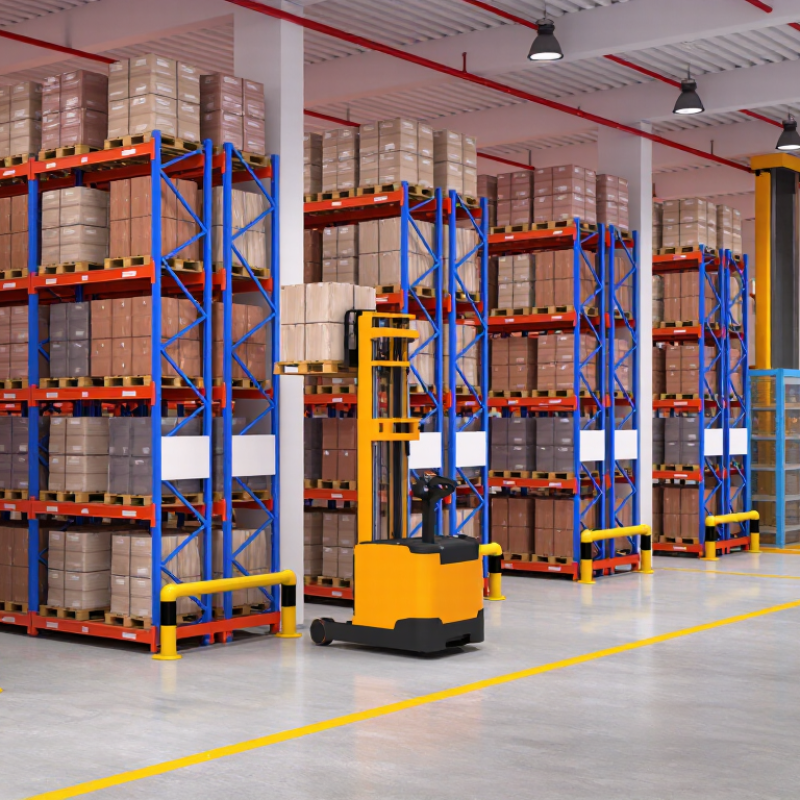
What Is the Best Narrow Aisle Storage Solution from China?

Define Narrow-Aisle Storage: 1.6–2.0 m Aisles and Core Applications

What Is the Best Narrow Aisle Storage Solution from China?

Define Narrow-Aisle Storage: 1.6–2.0 m Aisles and Core Applications

Narrow-aisle storage typically uses rack aisles from 1.6 to 2.0 meters wide. This layout increases pallet positions without expanding the building. However, aisle width must match the handling equipment. A standard counterbalance forklift may need more room. Reach trucks, turret trucks, or guided equipment are often more suitable. Small differences matter.

In practical warehouse planning, narrow aisles work well for distribution centers, cold storage rooms, spare-parts warehouses, and manufacturing plants. They support high-density pallet storage and direct access to individual loads. A 1.8-meter aisle may fit two-way movement in one facility. Another site may need stricter traffic control because of column spacing, floor quality, or operator visibility. Rack height, pallet weight, and load frequency also influence the design.

A reliable solution from China should include tested steel, accurate welding, stable uprights, and clear load ratings. Request drawings, material specifications, inspection records, and installation guidance. Check whether the equipment can turn safely inside the proposed aisle. Do not judge only by storage capacity. It can be misleading. Fire protection, emergency access, floor tolerance, and local safety requirements must remain part of the plan. In some projects, the narrowest layout looked efficient on paper but slowed picking in daily operations. A small pilot area can reveal that problem before full installation.

Compare VNA and Selective Racking: 30–50% More Pallet Capacity

What Is the Best Narrow Aisle Storage Solution from China?

For many Chinese warehouses, VNA racking can create 30–50% more pallet capacity than selective racking. This gain depends on building height, aisle width, pallet size, and handling equipment. Selective racking usually needs aisles around 2.7–3.5 metres wide. VNA layouts may reduce this to approximately 1.6–2.0 metres. More storage appears on the drawing. Operations may feel different on the floor.

The 2024 MHI Annual Industry Report identifies labor availability and warehouse utilization as continuing supply-chain concerns. That supports denser layouts, but density alone does not improve throughput. VNA needs suitable turret trucks, precise floor flatness, reliable guidance, and trained operators. Selective racking remains simpler when products change frequently or every pallet requires direct access. In practical sourcing projects from China, I would request load calculations, seismic assumptions, beam deflection limits, and installation tolerances. Do not accept “heavy duty” as a technical specification. It is too vague.

Tips: Compare usable pallet positions, not only rack height. Ask for a CAD layout showing columns, sprinklers, emergency exits, and charging areas. Test the proposed truck with your actual pallet dimensions. A 30–50% capacity increase can disappear when columns or fire clearances are ignored. The calculation may be optimistic. Review it twice.

Specify Forklifts: 10–15 m Lift Height, Turning Radius, and Load Safety

For narrow-aisle warehouses in China, the best storage solution starts with measured dimensions, not a catalog promise. A 10–15 m lift height requires a matched mast, carriage, and overhead clearance. Measure beam height, floor levelness, rack spacing, and pallet condition before requesting quotations. Small errors become expensive at height. Very expensive.

Turning radius must be checked with the actual pallet, not an empty vehicle. I once treated the unloaded radius as sufficient. That was a poor assumption. Check aisle width, load length, steering angle, and clearance from rack uprights. A practical trial should include entry, retrieval, reversing, and emergency stopping. Record the tightest movement. Do not rely on a drawing alone.

Load safety depends on the residual-capacity chart at the full lifting height. Ask for rated capacity, load-center limits, mast deflection data, braking performance, and overload protection. Confirm the floor’s rated capacity and inspect battery weight, tire condition, and visibility around the mast. Supplier documents should include test records, maintenance intervals, operator controls, and applicable safety compliance evidence. A factory audit can verify weld quality, hydraulic routing, and component traceability. These details show professional control, though they do not replace on-site commissioning. Chinese suppliers may offer attractive specifications, but performance can vary between units. Keep one sample pallet for repeat testing, and reassess the design after real operators report difficulties.

What Is the Best Narrow Aisle Storage Solution from China? – Specify Forklifts: 10–15 m Lift Height, Turning Radius, and Load Safety
Forklift Solution Recommended Lift Height Typical Rated Capacity
at 600 mm Load Centre
Typical Residual Capacity at High Lift Typical Outside Turning Radius Typical Working Aisle Width Load Handling Configuration Main Safety Controls Best Application
Electric Reach Truck 10–12 m 1.4–2.0 t Approximately 0.9–1.5 t at 10–12 m, depending on mast design, load centre, and battery weight 2.1–2.6 m 2.7–3.1 m Telescopic reach mechanism; forks normally face the rack directly Height and weight indicators, travel-speed reduction, mast tilt control, load backrest, overhead guard, emergency stop, and interlocked parking brake Selective pallet storage with frequent rack access and moderate aisle reduction
Man-Up VNA Turret Truck 10–15 m 1.0–1.5 t Approximately 0.7–1.2 t at 12–15 m; the approved load chart must be checked for every mast and load-centre combination 1.6–2.0 m 1.6–1.9 m Rotating or pivoting fork carriage for pallet placement on both sides of a very narrow aisle Wire or rail guidance, aisle-end speed control, platform interlock, door and gate detection, load-height limitation, anti-collision sensors, and emergency lowering Highest storage density where building height and rack investment justify VNA operation
Man-Down VNA Forklift 10–13 m 1.0–1.5 t Approximately 0.6–1.1 t at 10–13 m, subject to mast deflection, load centre, and attachment weight 1.7–2.1 m 1.8–2.1 m Fork carriage rotates or offsets while the operator remains at floor level Guided travel, automatic centring, rack-end protection, programmable travel limits, mast-height sensing, and residual-capacity monitoring High-density pallet storage with lower operator platform complexity than a man-up turret truck
Articulated Narrow Aisle Truck 10–15 m 1.2–1.6 t Approximately 0.8–1.3 t at 12–15 m, depending on articulation angle, load centre, and attachment 1.9–2.4 m 1.8–2.2 m Articulated mast or chassis allows the truck to enter narrow aisles and operate at the rack face Articulation-position monitoring, steering-angle limitation, speed control, anti-roll-back, load-height restriction, and stability alarms Mixed warehouse layouts where one truck must work in both narrow aisles and conventional pallet areas
High-Lift Reach Truck with Camera Assistance 12–15 m 1.2–1.8 t Approximately 0.8–1.3 t at 12–15 m; actual capacity must come from the truck’s certified residual-capacity plate 2.3–2.8 m 2.8–3.2 m Reach mast with fork camera, display, and optional laser or positioning assistance Load-height display, fork-position camera, automatic speed reduction, mast tilt limitation, overhead guard, and rack-impact protection Existing warehouses that need 12–15 m storage without converting fully to VNA aisles
Specification and safety note: The figures above are representative market ranges for electric narrow-aisle equipment and are not universal ratings for every configuration. Turning radius and aisle width vary with tyre size, pallet dimensions, rack design, fork length, battery type, and the method used for measurement. A high-lift truck must be selected using its manufacturer-approved residual-capacity chart, rated load centre, mast configuration, attachment weight, and floor conditions. For safe procurement, verify compliance with applicable requirements such as ISO 22915, EN 16307-1, EN 1175, local occupational-safety regulations, and the rack supplier’s load specifications.
Practical selection guidance: For the narrowest aisles and maximum pallet density, a man-up VNA turret truck is generally the most space-efficient option. For a balance between flexibility, 10–12 m lifting performance, and lower infrastructure requirements, an electric reach truck is usually the more practical choice. For 15 m storage with mixed aisle conditions, an articulated or high-lift reach solution may reduce the need for specialized VNA infrastructure.

Evaluate Chinese Suppliers: GB Standards, CE Compliance, and Automation

What Is the Best Narrow Aisle Storage Solution from China?

When evaluating Chinese narrow aisle suppliers, begin with the storage task, not the catalog. Check pallet dimensions, load weights, turnover rates, aisle width, floor flatness, and required lifting height. A practical supplier should provide load calculations, layout drawings, and test records. Ask how the system performs in a cold warehouse or under uneven operating patterns. Small details matter.

GB standards are important for manufacturing, structural safety, electrical systems, and warehouse equipment. Request the exact standard numbers and testing scope. Do not accept “GB compliant” as a complete answer. The phrase may cover only selected components.

For exported equipment, CE compliance also needs careful review. CE marking relates to applicable European requirements, such as machinery, electromagnetic compatibility, or electrical safety. It is not a blanket approval. Review the Declaration of Conformity, risk assessment, manuals, and test reports.

Automation should match your real workflow. Ask for demonstrations of sensors, barcode scanning, warehouse software integration, emergency stops, and manual recovery procedures. A supplier may promise high throughput, yet ignore charging time or operator training. That assumption can fail. Request a factory audit, sample inspection, and reference projects with similar loads. I would also verify weld quality, surface treatment, spare-part availability, and response times. A lower quotation may look attractive, but weak documentation can create expensive delays. Some suppliers communicate well during sales and poorly after installation. Test that relationship before signing.

Calculate Total Cost: Space, Labor, Maintenance, and 3–5-Year Payback

What Is the Best Narrow Aisle Storage Solution from China?

The best solution is not always the densest one. It must reduce total cost across space, labor, maintenance, and downtime. A narrow aisle layout can add pallet positions without expanding the building. However, it may require specialized trucks, smoother floors, and stricter operator training.

Build a five-year cost model before requesting quotations. Include equipment, racks, shipping, installation, electrical work, floor repairs, inspections, spare parts, and software integration. Then estimate labor savings from shorter travel routes and faster picking. For example, if a redesign saves two operator-hours daily, multiply that saving by working days and loaded labor costs. Compare the result with the investment. A simple payback formula is total investment divided by annual net savings. A three-year payback may be attractive, but only if maintenance and downtime assumptions are realistic.

Tips: Measure aisle width, ceiling height, pallet dimensions, and floor flatness first. Ask for load calculations, safety documentation, warranty terms, and spare-parts availability. Request a reference installation with similar pallet weights. Do not accept projected capacity without checking actual maneuvering space. A small error here can erase the expected savings. Also budget for training and commissioning. These costs are often overlooked. A supplier’s low initial price may become expensive when local installation support is weak. Recheck every assumption with warehouse staff, because spreadsheets rarely show blocked aisles, damaged pallets, or peak-season congestion.

FAQS

What should I check before choosing a narrow aisle storage supplier?

Start with your storage task, not the supplier’s catalog. Measure pallet size, load weight, aisle width, ceiling height, and floor flatness. Ask for load calculations, layout drawings, and test records. Small measurements matter.

How can I verify GB standards compliance?

Request the exact GB standard numbers and testing scope. Do not accept “GB compliant” as a complete explanation. Some suppliers may cover only selected components. Check structural, electrical, manufacturing, and safety requirements separately.

What documents should support CE compliance?

Request the Declaration of Conformity, risk assessment, manuals, and test reports. Confirm which requirements apply to the equipment. A CE marking is not blanket approval. Review the details carefully.

What should an automation demonstration include?

Ask to see sensors, barcode scanning, software integration, and emergency stops. The demonstration should include manual recovery procedures. Ask how charging time affects daily output. Promises can look better than reality.

How should I calculate the total project cost?

Include equipment, racks, shipping, installation, electrical work, and floor repairs. Add inspections, software integration, spare parts, training, and commissioning. Also estimate maintenance and downtime. The quotation is only one piece.

How can I estimate the payback period?

Divide total investment by annual net savings. Estimate savings from shorter travel routes and fewer operator-hours. For example, two saved hours daily can become meaningful yearly savings. Check labor costs and working days. The spreadsheet may still be optimistic.

What operational risks can narrow aisles create?

Narrow aisles may require specialized trucks and smoother floors. Operators need stricter training and careful maneuvering. Damaged pallets can block a tight aisle quickly. Peak-season congestion may reduce expected efficiency.

How should I evaluate after-sales support?

Request spare-parts availability, warranty terms, response times, and installation support. Visit or inspect a similar reference project when possible. Test communication before signing. Sales support may not continue after installation.

Conclusion

Narrow Aisle Storage is an efficient warehouse solution for facilities with aisles approximately 1.6–2.0 meters wide. It is well suited to distribution centers, cold storage, manufacturing warehouses, and other operations where floor space is limited but pallet access must remain organized. Compared with conventional selective racking, very narrow aisle systems can increase pallet capacity by around 30–50%, provided that the layout, rack height, and material-flow requirements are carefully planned.

A successful project should match the racking system with suitable forklifts capable of lifting 10–15 meters, operating safely within restricted turning radii, and handling the required loads. When evaluating suppliers in China, buyers should review manufacturing quality, GB standards, CE compliance, safety features, installation support, and available automation options. The total cost should include space savings, labor efficiency, equipment, maintenance, and training. With proper planning, a three- to five-year payback period may be achievable while improving storage density, safety, and long-term operational flexibility.

Aria

Aria

Aria is a dedicated marketing professional with a deep passion for innovative strategies and a keen understanding of our company's product offerings. With a wealth of experience in the industry, Aria excels at crafting engaging content that highlights the unique features and benefits of our......